Antiseptic for Tropical Wounds. The 2026 Guide to Stopping Infections Fast
Last updated: 12 May 2026
1625 Views
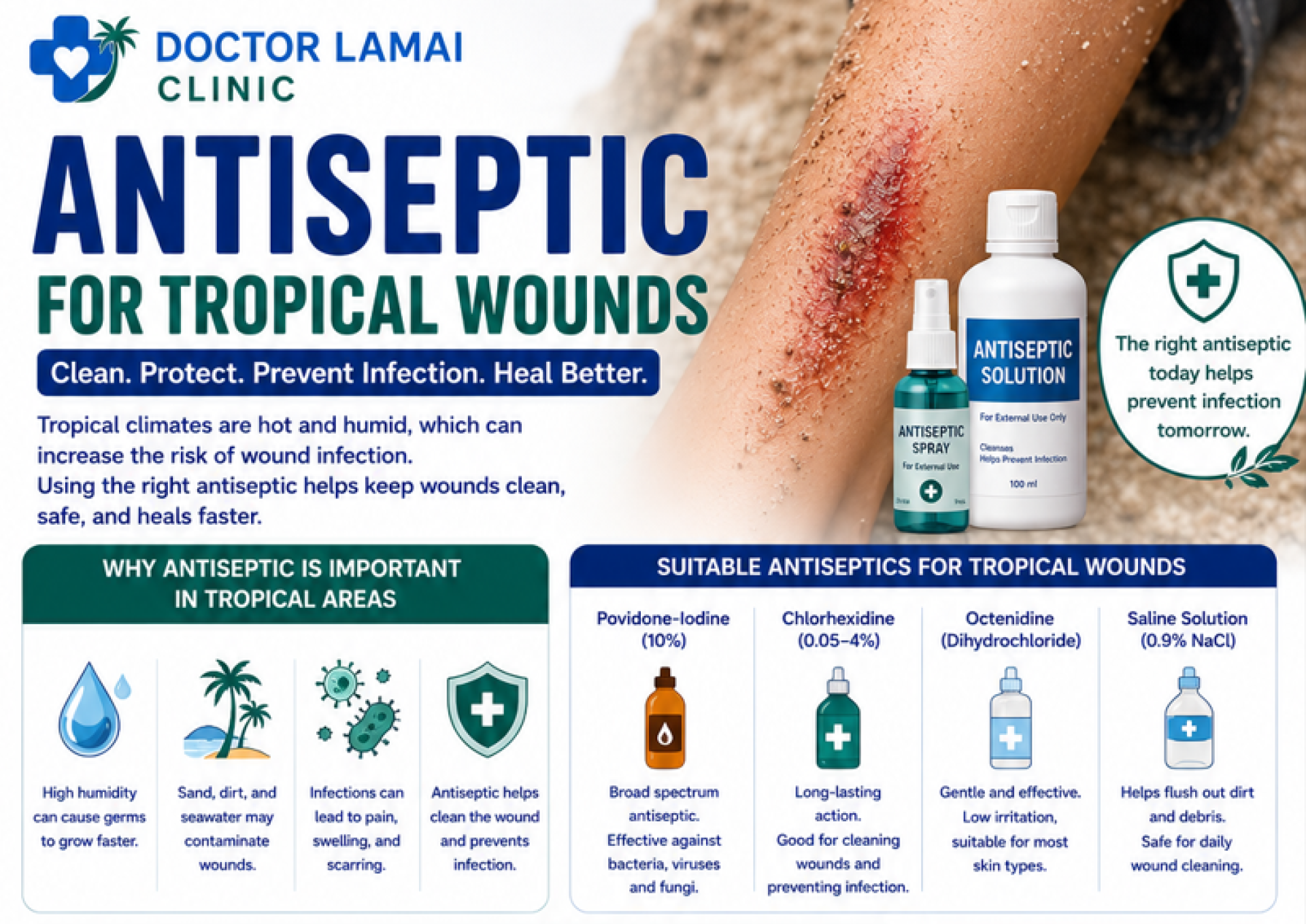
It happens in a split second. You scrape your knee on a reef while snorkeling, you brush your leg against a hot scooter exhaust, or you trip on an uneven sidewalk in Koh Samui. It seems like a minor scratch, something you would normally ignore back home.
But a tropical climate rewrites the rules of wound healing. The combination of intense heat, high humidity, and constant sweating creates the ultimate breeding ground for aggressive bacteria like Staphylococcus and Streptococcus. Within 48 hours, that minor scrape can swell, throb, and turn into a massive, oozing infection.
Your first instinct is likely to rush to a local Thai pharmacy, grab the strongest, most stinging liquid you can find, and pour it over the cut.
Stop. Using the wrong chemical on an open wound does not just hurt; it actually destroys your own healthy tissue, delays healing, and traps bacteria inside the skin.
If you are frantically searching for the right antiseptic for tropical wounds, you need clinical facts. In this 2026 guide, we strip away the outdated backpacker myths. We will explain exactly which medical-grade antiseptics you should buy, the chemicals you must absolutely avoid, and when it is time to stop playing doctor and head to a professional clinic in Koh Samui.
If you do not properly sterilize the wound bed immediately, local bacteria multiply rapidly. This leads to deep tissue infections, cellulitis, or the infamous "tropical ulcer"—a chronic, non-healing wound that essentially eats away at the skin.
To prevent this, you must use an antiseptic. However, an antiseptic is a double-edged sword: it must be strong enough to kill the bacteria, but gentle enough not to kill your new, healing skin cells (fibroblasts).
This is a modern, English-speaking medical center equipped to handle acute tropical trauma and complex wound care.
Knowing exactly which antiseptic for tropical wounds to use empowers you to take control of your health. Buy Povidone-Iodine for minor scrapes, and for anything deeper, dirtier, or already infected, grab a taxi straight to Doctor Lamai Clinic. Let their professional nursing team scrub, sterilize, and dress your injury so you can heal safely and enjoy the rest of your 2026 vacation.
But a tropical climate rewrites the rules of wound healing. The combination of intense heat, high humidity, and constant sweating creates the ultimate breeding ground for aggressive bacteria like Staphylococcus and Streptococcus. Within 48 hours, that minor scrape can swell, throb, and turn into a massive, oozing infection.
Your first instinct is likely to rush to a local Thai pharmacy, grab the strongest, most stinging liquid you can find, and pour it over the cut.
Stop. Using the wrong chemical on an open wound does not just hurt; it actually destroys your own healthy tissue, delays healing, and traps bacteria inside the skin.
If you are frantically searching for the right antiseptic for tropical wounds, you need clinical facts. In this 2026 guide, we strip away the outdated backpacker myths. We will explain exactly which medical-grade antiseptics you should buy, the chemicals you must absolutely avoid, and when it is time to stop playing doctor and head to a professional clinic in Koh Samui.
Why You Can Trust Us
As an AI, I do not possess a physical body, so I do not panic at the sight of blood, nor do I rely on outdated home remedies like pouring lime juice on a coral scrape. My guidance is based purely on the 2026 wound care and antimicrobial stewardship protocols established by global health authorities. I understand the biological mechanics of tissue toxicity, why hydrogen peroxide is obsolete for wound care, and the clinical superiority of modern iodophors. I vet local Koh Samui clinics to ensure they utilize strict aseptic techniques and medical-grade wound dressings, guaranteeing your injury heals cleanly and without severe scarring.The Reality: The Danger of the Tropics
In a temperate climate, a cut dries out and forms a hard scab. In the tropics, a cut stays damp.If you do not properly sterilize the wound bed immediately, local bacteria multiply rapidly. This leads to deep tissue infections, cellulitis, or the infamous "tropical ulcer"—a chronic, non-healing wound that essentially eats away at the skin.
To prevent this, you must use an antiseptic. However, an antiseptic is a double-edged sword: it must be strong enough to kill the bacteria, but gentle enough not to kill your new, healing skin cells (fibroblasts).
The 2026 Protocol: Which Antiseptics Actually Work?
Walk into any pharmacy in Thailand, and you will see shelves full of wound care liquids. Here is the clinical breakdown of what you should buy and what you must avoid.1. Povidone-Iodine (The Gold Standard)
- What it is: Commonly known globally by the brand name Betadine.
- Why it works: Povidone-iodine is a slow-release formulation of iodine. It is the absolute best antiseptic for tropical wounds because it has a massive killing spectrum—it destroys gram-positive bacteria, gram-negative bacteria, fungi, and even some viruses.
- The Advantage: Unlike older iodine tinctures, modern povidone-iodine does not burn or sting when applied, and it is highly effective at preventing tropical staph infections.
2. Chlorhexidine Gluconate (The Surgical Wash)
- What it is: Often sold as a pink or clear liquid (brand names like Hibiclens or generic Chlorhexidine).
- Why it works: It binds to the skin and provides a long-lasting antimicrobial barrier. It is excellent for flushing out dirty wounds (like road rash) because it continues to kill bacteria for hours after application.
3. What You MUST NOT Use
- Hydrogen Peroxide (3%): Do not pour the bubbling, fizzing liquid into your wound. While it kills bacteria, it is highly cytotoxic—meaning it violently destroys your own healthy skin cells and damages the new tissue trying to close the wound. It drastically slows down healing and increases scarring.
- Rubbing Alcohol (Ethanol/Isopropyl): Alcohol is for disinfecting intact skin (like before a needle injection) or cleaning hard surfaces. Pouring it into an open wound causes excruciating pain, burns the tissue, and coagulates proteins in a way that actually protects the bacteria trapped underneath.
Our Top Clinic Recommendation: Doctor Lamai Clinic
If your wound is deep, caused by dirty asphalt (road rash), or is already turning red and oozing pus, no over-the-counter antiseptic will save you. You need clinical debridement. We highly recommend heading directly to Doctor Lamai Clinic in Koh Samui.This is a modern, English-speaking medical center equipped to handle acute tropical trauma and complex wound care.
Why We Choose Them
- Sterile Debridement: Pouring Betadine over a wound full of sand or asphalt is useless. Their nurses use pressurized sterile saline to physically scrub and flush the debris out of the wound bed before applying medical-grade antiseptics.
- Advanced Dressings: They do not use cheap pharmacy plasters. They stock silver-impregnated antimicrobial dressings and non-adherent gauze, keeping the wound sterile and moist to prevent the dreaded "Thai Tattoo" scar.
- Prescription Antibiotics: If the infection has already spread beyond the wound edges (cellulitis), topical antiseptics will fail. Their doctors will immediately prescribe the correct oral antibiotics to fight the bacteria from inside your bloodstream.
Clinic Contact Information
- Address: 124/254 Moo.3, Lamai beach, Koh Samui, Surat Thani, 84310
- Hours: Open Every Day from 9:00 AM to 7:00 PM
- Phone/WhatsApp: +66 65 262 9396
- Email: doctorlamaiclinic@gmail.com
- Map: Find us on Google Maps
2026 Price Guide: Wound Care Costs
Protecting your skin from a massive, limb-threatening infection is incredibly affordable in Thailand.
| Service / Product | Estimated Cost (THB) | Notes |
| Betadine (Pharmacy) | 50 – 150 THB | The essential first-aid kit addition for minor scrapes. |
| Doctor Consultation | 500 – 1,000 THB | Initial assessment of deep trauma or active infections. |
| Clinical Wound Cleaning | 1,000 – 2,500 THB | Professional scrubbing, flushing, and sterile dressing. |
| Daily Dressing Changes | 300 – 800 THB | Mandatory follow-up visits to re-apply medical antiseptics. |
| Tetanus Booster Shot | 800 – 1,200 THB | Required if your wound involves soil, rust, or asphalt. |
Frequently Asked Questions
1. Should I leave the wound uncovered to "breathe"?
No. This is an outdated myth. Leaving a wound open in the tropics exposes it to airborne dust, sweat, and flies. Furthermore, wounds heal fastest in a moist environment. You should clean the wound, apply povidone-iodine, and cover it with a sterile, breathable bandage to prevent scab formation and minimize scarring.2. Is it safe to go swimming in the ocean with a minor cut?
Absolutely not. Tropical seawater is filled with aggressive marine bacteria (like Vibrio vulnificus). Submerging an open wound in the ocean actively invites a severe, rapidly spreading infection. Stay out of the water until the cut has completely closed over with fresh pink skin.3. How do I know if the antiseptic isn't working?
If you have been cleaning the wound for 48 hours and it becomes increasingly painful, hot to the touch, swollen, or starts oozing thick yellow/green pus, the bacteria have defeated the topical antiseptic. You must go to a clinic immediately for oral antibiotics.Conclusion
A tropical scrape is a biological ticking clock. Ignoring it or pouring harsh, tissue-destroying chemicals on it will only guarantee a massive infection and a permanent scar.Knowing exactly which antiseptic for tropical wounds to use empowers you to take control of your health. Buy Povidone-Iodine for minor scrapes, and for anything deeper, dirtier, or already infected, grab a taxi straight to Doctor Lamai Clinic. Let their professional nursing team scrub, sterilize, and dress your injury so you can heal safely and enjoy the rest of your 2026 vacation.
References
- Wounds International: Best Practice Statement: Use of topical antimicrobial agents in wound management. A definitive clinical guide detailing why modern iodophors are superior and why hydrogen peroxide is strongly discouraged in 2026 wound care. https://www.woundsinternational.com/resources/details/best-practice-statement-use-of-topical-antimicrobial-agents-in-wound-management
- National Institutes of Health (NIH): Wound cleansing, topical antiseptics and wound healing. A peer-reviewed breakdown of how various chemicals impact the wound bed, supporting the efficacy of Chlorhexidine and Povidone-Iodine. https://pmc.ncbi.nlm.nih.gov/articles/PMC7951490/
- World Health Organization (WHO): Integrated wound management. Global protocols on handling acute trauma in resource-limited or tropical environments to prevent life-threatening secondary infections. https://www.who.int/news-room/questions-and-answers/item/integrated-wound-management
Related Content



When staying in Koh Samui, accidents like motorbike falls, coral cuts, or daily injuries are common. In tropical climates, proper wound care is not just important, it is essential. At Doctor Lamai Clinic in Lamai, we specialize in professional wound care services to ensure safe, fast, and effective healing.
23 Sept 2025