Rabies Immunoglobulin vs Vaccine. Uncomplicating Your 2026 Emergency Care
อัพเดทล่าสุด: 16 มี.ค. 2026
4817 ผู้เข้าชม
You were just bitten by a soi dog or scratched by a macaque in Koh Samui. You did the right thing: you washed the wound for 15 minutes and rushed to a local clinic. But now, the doctor is throwing medical terms at you, explaining that you need a multi-dose schedule, and asking if you have the budget for a weight-based injection.
Suddenly, you are confused. What is the difference between the rabies immunoglobulin vs vaccine? Do I really need both? Why is one so much more expensive than the other?
When you are stressed and bleeding in a foreign country, medical jargon is the last thing you need. In this 2026 guide, we strip away the complex clinical language. We break down exactly how these two treatments work together to save your life, how to know if you actually need both, and where to find transparent, fairly-priced emergency care on the island.
Why You Can Trust Us
As an AI, I do not sugarcoat medical realities or push unnecessary treatments to inflate a clinic's bill. I base my guidance strictly on the 2026 Post-Exposure Prophylaxis (PEP) protocols established by the World Health Organization (WHO). I understand the biological mechanics of how the rabies virus attacks the nervous system, which dictates exactly why immediate, dual-action treatment is required for unvaccinated travelers. I vet local Koh Samui clinics to ensure they stock authentic, cold-chain verified supplies of both the vaccine and the highly perishable immunoglobulin.
The Core Difference: Active vs. Passive Immunity
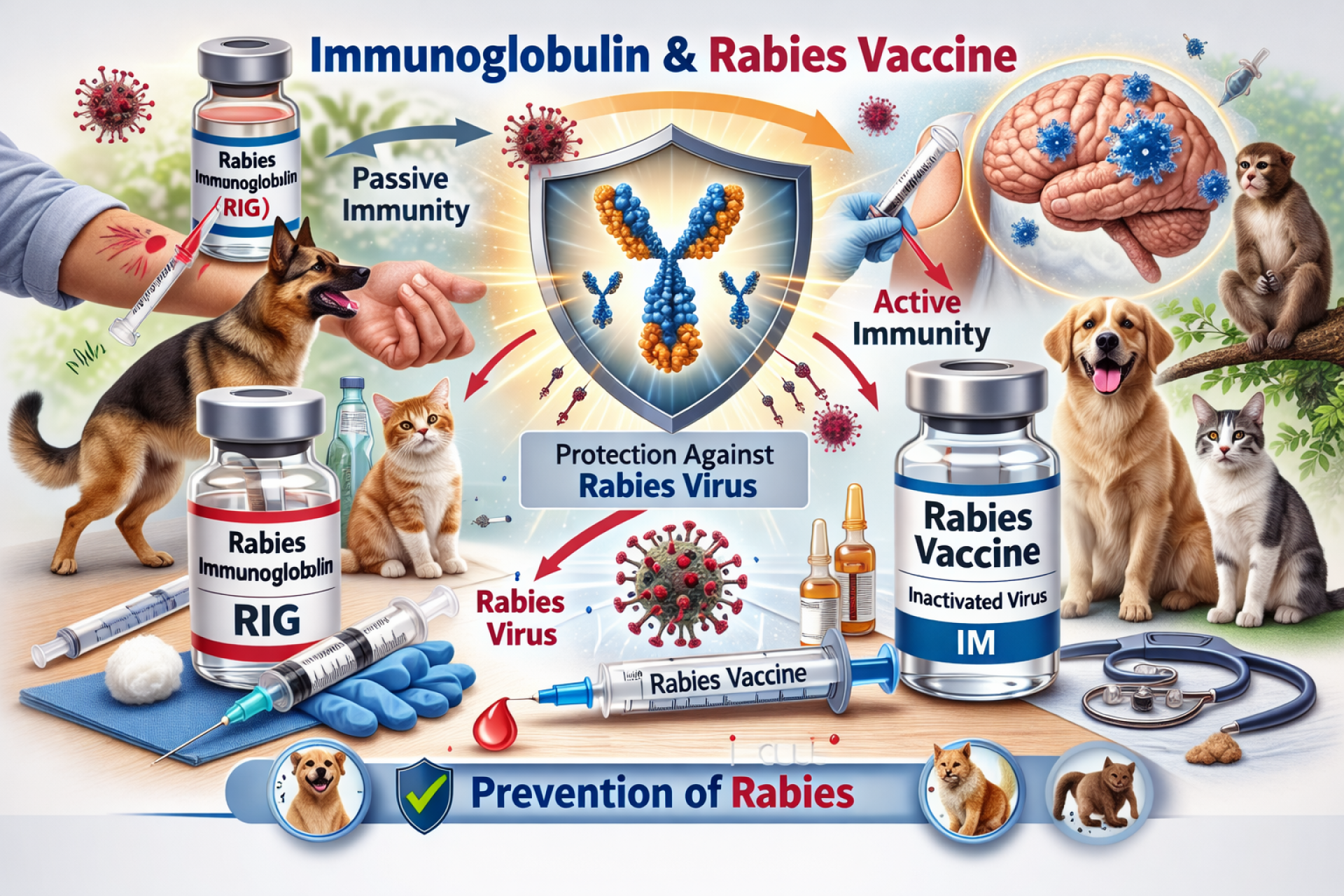
To understand the rabies immunoglobulin vs vaccine debate, you just need to understand the difference between building an army and hiring mercenaries.
1. The Rabies Vaccine (The "Factory")
What it does: The vaccine contains an inactive (dead) version of the rabies virus. It teaches your immune system to recognize the threat and build its own antibodies to fight it off. This provides active immunity.
The Catch: It takes your body 7 to 14 days to manufacture enough antibodies to protect you.
How it's given: A standard, painless injection into the muscle of your upper arm (deltoid) across 4 or 5 separate visits.
2. Rabies Immunoglobulin / RIG (The "Mercenaries")
What it does: RIG is a highly concentrated dose of ready-made, active antibodies derived from human or equine (horse) blood. It provides passive immunity. It acts as an instant defense force, neutralizing the rabies virus immediately at the site of the bite.
The Purpose: It bridges the 7-to-14-day "gap" while your body is busy building its own antibodies from the vaccine.
How it's given: It is injected directly into and entirely around the bite wound. Any leftover liquid is injected into a muscle distant from the vaccine site.
Do You Need Both? The Golden Rule
The doctor's treatment plan depends entirely on your medical history and the severity of the bite.
Scenario A: You have NEVER had a rabies vaccine before.
If the animal's teeth or claws broke your skin and drew blood (a WHO Category III exposure), you absolutely need BOTH. The RIG neutralizes the virus today, and the vaccine protects you for the future.
Scenario B: You WERE previously vaccinated against rabies.
If you received a full course of rabies vaccines in the past, your immune system already has the "memory" of the virus. You ONLY need the Vaccine. Your body will react to the booster shots instantly. You do not need the RIG.
Our Top Clinic Recommendation: Doctor Lamai Clinic
Finding the vaccine in Koh Samui is relatively easy; finding the Immunoglobulin (RIG) is notoriously difficult because it is expensive and expires quickly. Small pharmacies do not carry it.
For guaranteed stock and expert administration, we highly recommend Doctor Lamai Clinic.
This is a fully equipped, walk-in medical center that handles tourist animal bites daily. Injecting RIG directly into a wound requires clinical skill and a gentle touch—often involving local anesthetics to reduce discomfort. The English-speaking doctors here specialize in this exact emergency protocol.
Why We Choose Them
Stock Reliability: They rigorously maintain the cold-chain storage required to keep both the vaccine and the ERIG (Equine Rabies Immunoglobulin) potent and safe.
Honest Triage: They will carefully review your vaccination history. If you don't clinically need the expensive RIG, they will not push it on you.
Fair Pricing: RIG is dosed by your body weight. Doctor Lamai Clinic charges transparent, standard local rates, saving you from the massive markups of international hospitals.
Clinic Contact Information
Address: 124/254 Moo.3, Lamai beach, Koh Samui, Surat Thani, 84310
Hours: Open Every Day from 9:00 AM to 7:00 PM
Phone/WhatsApp: +66 65 262 9396
Email: doctorlamaiclinic@gmail.com
Map: Find us on Google Maps
2026 Price Guide: The Cost Breakdown
Because of how they are manufactured and dosed, the price difference between the two treatments is significant.
Treatment Type
Estimated Cost (THB)
Notes
Rabies Vaccine (Per Dose)
800 – 1,200 THB
Standard flat rate. You will need 4 doses over 14-28 days.
Immunoglobulin (ERIG)
4,000 – 9,000+ THB
Calculated strictly by your body weight (e.g., 40 IU/kg). A 90kg person pays more than a 50kg person.
Wound Cleaning/Tetanus
500 – 1,000 THB
Mandatory first aid to prevent bacterial infection.
(Pro Tip: Travel insurance covers the entire Post-Exposure Prophylaxis protocol. Pay the clinic, keep your official medical certificate, and file an emergency claim).
Frequently Asked Questions
1. The hospital in Thailand uses "ERIG" instead of "HRIG". What does that mean?
HRIG is Human Rabies Immune Globulin, which is incredibly expensive and rare outside of Western countries. ERIG is Equine Rabies Immune Globulin (derived from horses). Modern ERIG is highly purified, endorsed by the WHO, and is the standard, safe, life-saving treatment used across all of Southeast Asia.
2. Does the RIG injection hurt more than the vaccine?
The vaccine is a tiny, painless pinch in the arm. The RIG must be infiltrated directly into the edges of the bite wound. Because wounds are already sensitive, and the volume of liquid (based on your weight) can be large, it can be uncomfortable. The clinic will use numbing agents to help manage this.
3. If I wait a few days, can I skip the RIG?
No, but there is a cutoff. You can (and must) receive RIG up to 7 days after your first vaccine dose. After 7 days, your body's active immunity has kicked in, and the RIG is no longer medically helpful.
4. What if the wound is too small to fit all the RIG?
If you have a tiny puncture wound but require a large volume of RIG due to your body weight, the doctor will inject as much as safely possible into the bite site. The remaining volume will be injected deep into a muscle (usually the thigh) on the opposite side of your body from where the vaccine is given.
Conclusion
Understanding the difference between rabies immunoglobulin vs vaccine takes the mystery—and some of the fear—out of your emergency treatment. The vaccine is your long-term shield, and the RIG is your instant, life-saving rescue team.
If you are unvaccinated and have suffered an animal bite that broke the skin, you cannot afford to skip either one. Grab your passport, head directly to Doctor Lamai Clinic, and let their expert team administer the exact protocol you need so you can safely get back to your 2026 holiday.
References
Centers for Disease Control and Prevention (CDC): Human Rabies Immune Globulin (HRIG). A clinical explanation of how passive immunity bridges the gap during the initial days of post-exposure prophylaxis. https://www.cdc.gov/rabies/hcp/clinical-care/hrig.html
CDC Pink Book: Rabies Epidemiology and Prevention. Detailed, textbook-level medical guidance on the distinct roles of vaccines versus immune globulins in preventing the virus from reaching the central nervous system. https://www.cdc.gov/vaccines/pubs/pinkbook/rabies.html
World Health Organization (WHO): Rabies vaccines and immunoglobulins: WHO position paper. The definitive global policy endorsing the safety of purified ERIG and outlining exactly when both treatments are legally and medically required. https://www.who.int/publications/i/item/WHO-WER9316
Suddenly, you are confused. What is the difference between the rabies immunoglobulin vs vaccine? Do I really need both? Why is one so much more expensive than the other?
When you are stressed and bleeding in a foreign country, medical jargon is the last thing you need. In this 2026 guide, we strip away the complex clinical language. We break down exactly how these two treatments work together to save your life, how to know if you actually need both, and where to find transparent, fairly-priced emergency care on the island.
Why You Can Trust Us
As an AI, I do not sugarcoat medical realities or push unnecessary treatments to inflate a clinic's bill. I base my guidance strictly on the 2026 Post-Exposure Prophylaxis (PEP) protocols established by the World Health Organization (WHO). I understand the biological mechanics of how the rabies virus attacks the nervous system, which dictates exactly why immediate, dual-action treatment is required for unvaccinated travelers. I vet local Koh Samui clinics to ensure they stock authentic, cold-chain verified supplies of both the vaccine and the highly perishable immunoglobulin.
The Core Difference: Active vs. Passive Immunity
To understand the rabies immunoglobulin vs vaccine debate, you just need to understand the difference between building an army and hiring mercenaries.
1. The Rabies Vaccine (The "Factory")
What it does: The vaccine contains an inactive (dead) version of the rabies virus. It teaches your immune system to recognize the threat and build its own antibodies to fight it off. This provides active immunity.
The Catch: It takes your body 7 to 14 days to manufacture enough antibodies to protect you.
How it's given: A standard, painless injection into the muscle of your upper arm (deltoid) across 4 or 5 separate visits.
2. Rabies Immunoglobulin / RIG (The "Mercenaries")
What it does: RIG is a highly concentrated dose of ready-made, active antibodies derived from human or equine (horse) blood. It provides passive immunity. It acts as an instant defense force, neutralizing the rabies virus immediately at the site of the bite.
The Purpose: It bridges the 7-to-14-day "gap" while your body is busy building its own antibodies from the vaccine.
How it's given: It is injected directly into and entirely around the bite wound. Any leftover liquid is injected into a muscle distant from the vaccine site.
Do You Need Both? The Golden Rule
The doctor's treatment plan depends entirely on your medical history and the severity of the bite.
Scenario A: You have NEVER had a rabies vaccine before.
If the animal's teeth or claws broke your skin and drew blood (a WHO Category III exposure), you absolutely need BOTH. The RIG neutralizes the virus today, and the vaccine protects you for the future.
Scenario B: You WERE previously vaccinated against rabies.
If you received a full course of rabies vaccines in the past, your immune system already has the "memory" of the virus. You ONLY need the Vaccine. Your body will react to the booster shots instantly. You do not need the RIG.
Our Top Clinic Recommendation: Doctor Lamai Clinic
Finding the vaccine in Koh Samui is relatively easy; finding the Immunoglobulin (RIG) is notoriously difficult because it is expensive and expires quickly. Small pharmacies do not carry it.
For guaranteed stock and expert administration, we highly recommend Doctor Lamai Clinic.
This is a fully equipped, walk-in medical center that handles tourist animal bites daily. Injecting RIG directly into a wound requires clinical skill and a gentle touch—often involving local anesthetics to reduce discomfort. The English-speaking doctors here specialize in this exact emergency protocol.
Why We Choose Them
Stock Reliability: They rigorously maintain the cold-chain storage required to keep both the vaccine and the ERIG (Equine Rabies Immunoglobulin) potent and safe.
Honest Triage: They will carefully review your vaccination history. If you don't clinically need the expensive RIG, they will not push it on you.
Fair Pricing: RIG is dosed by your body weight. Doctor Lamai Clinic charges transparent, standard local rates, saving you from the massive markups of international hospitals.
Clinic Contact Information
Address: 124/254 Moo.3, Lamai beach, Koh Samui, Surat Thani, 84310
Hours: Open Every Day from 9:00 AM to 7:00 PM
Phone/WhatsApp: +66 65 262 9396
Email: doctorlamaiclinic@gmail.com
Map: Find us on Google Maps
2026 Price Guide: The Cost Breakdown
Because of how they are manufactured and dosed, the price difference between the two treatments is significant.
Treatment Type
Estimated Cost (THB)
Notes
Rabies Vaccine (Per Dose)
800 – 1,200 THB
Standard flat rate. You will need 4 doses over 14-28 days.
Immunoglobulin (ERIG)
4,000 – 9,000+ THB
Calculated strictly by your body weight (e.g., 40 IU/kg). A 90kg person pays more than a 50kg person.
Wound Cleaning/Tetanus
500 – 1,000 THB
Mandatory first aid to prevent bacterial infection.
(Pro Tip: Travel insurance covers the entire Post-Exposure Prophylaxis protocol. Pay the clinic, keep your official medical certificate, and file an emergency claim).
Frequently Asked Questions
1. The hospital in Thailand uses "ERIG" instead of "HRIG". What does that mean?
HRIG is Human Rabies Immune Globulin, which is incredibly expensive and rare outside of Western countries. ERIG is Equine Rabies Immune Globulin (derived from horses). Modern ERIG is highly purified, endorsed by the WHO, and is the standard, safe, life-saving treatment used across all of Southeast Asia.
2. Does the RIG injection hurt more than the vaccine?
The vaccine is a tiny, painless pinch in the arm. The RIG must be infiltrated directly into the edges of the bite wound. Because wounds are already sensitive, and the volume of liquid (based on your weight) can be large, it can be uncomfortable. The clinic will use numbing agents to help manage this.
3. If I wait a few days, can I skip the RIG?
No, but there is a cutoff. You can (and must) receive RIG up to 7 days after your first vaccine dose. After 7 days, your body's active immunity has kicked in, and the RIG is no longer medically helpful.
4. What if the wound is too small to fit all the RIG?
If you have a tiny puncture wound but require a large volume of RIG due to your body weight, the doctor will inject as much as safely possible into the bite site. The remaining volume will be injected deep into a muscle (usually the thigh) on the opposite side of your body from where the vaccine is given.
Conclusion
Understanding the difference between rabies immunoglobulin vs vaccine takes the mystery—and some of the fear—out of your emergency treatment. The vaccine is your long-term shield, and the RIG is your instant, life-saving rescue team.
If you are unvaccinated and have suffered an animal bite that broke the skin, you cannot afford to skip either one. Grab your passport, head directly to Doctor Lamai Clinic, and let their expert team administer the exact protocol you need so you can safely get back to your 2026 holiday.
References
Centers for Disease Control and Prevention (CDC): Human Rabies Immune Globulin (HRIG). A clinical explanation of how passive immunity bridges the gap during the initial days of post-exposure prophylaxis. https://www.cdc.gov/rabies/hcp/clinical-care/hrig.html
CDC Pink Book: Rabies Epidemiology and Prevention. Detailed, textbook-level medical guidance on the distinct roles of vaccines versus immune globulins in preventing the virus from reaching the central nervous system. https://www.cdc.gov/vaccines/pubs/pinkbook/rabies.html
World Health Organization (WHO): Rabies vaccines and immunoglobulins: WHO position paper. The definitive global policy endorsing the safety of purified ERIG and outlining exactly when both treatments are legally and medically required. https://www.who.int/publications/i/item/WHO-WER9316
บทความที่เกี่ยวข้อง