Prescription Refill Koh Samui. The 2026 Guide to Safely Replacing Your Medication
Last updated: 22 May 2026
2273 Views
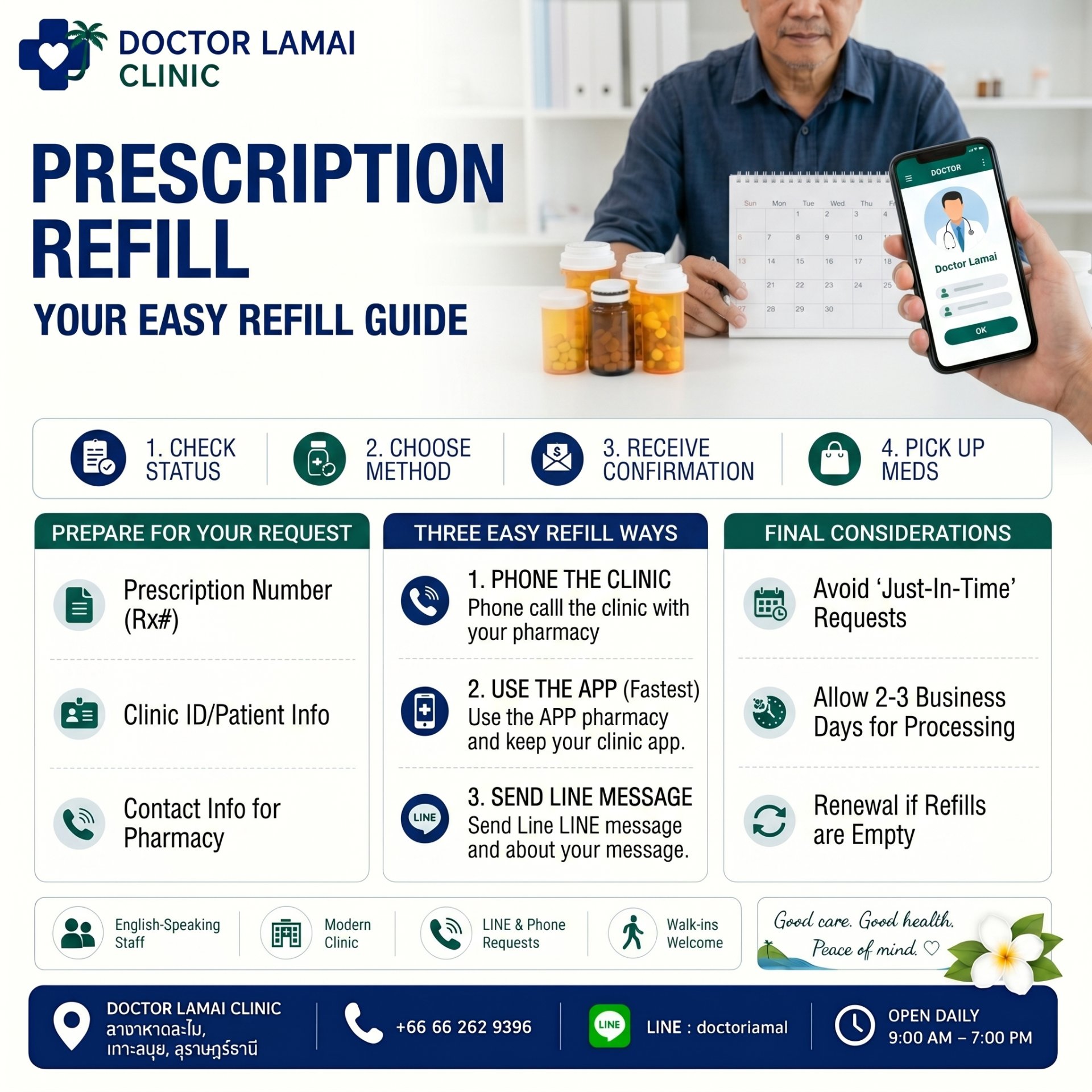
You packed perfectly for your tropical holiday, but life happens. Perhaps your luggage was lost in transit, your flight home was delayed by a week, or you simply miscounted your daily pills.
Suddenly, you are staring at an empty pill bottle. If you rely on daily medication for blood pressure, asthma, thyroid conditions, or mental health (like SSRIs), the realization that you have run out is panic-inducing.
Your first instinct might be to walk into a local Thai pharmacy, hand the pharmacist your piece of paper from your doctor back in London, Sydney, or New York, and ask them to fill it.
You will quickly discover a frustrating reality: Foreign prescriptions hold no legal weight in Thailand. While Thai pharmacies are excellent and can dispense many basic medications over the counter, strictly regulated drugs require an assessment and a prescription from a licensed Thai medical doctor.
If you are frantically searching for a legal, safe prescription refill koh samui, you need to know how the local medical system classifies your drugs. In this 2026 guide, we strip away the bureaucratic confusion. We will explain how to safely match your foreign medication to a Thai equivalent, the legal protocols for restricted drugs, and exactly where to find an English-speaking clinic to get your medication sorted today.
This is a modern, English-speaking medical center equipped to handle international patients and their specific pharmaceutical needs.
Do not waste time arguing with street pharmacists who are legally bound by Thai drug laws. Securing a legal, safe prescription refill koh samui is a fast and routine process when you visit the right facility. Grab your empty pill bottles and your passport, take a taxi directly to Doctor Lamai Clinic, and let their professional, English-speaking doctors assess your needs and dispense the exact medication you need to stay healthy and enjoy the rest of your trip.
Suddenly, you are staring at an empty pill bottle. If you rely on daily medication for blood pressure, asthma, thyroid conditions, or mental health (like SSRIs), the realization that you have run out is panic-inducing.
Your first instinct might be to walk into a local Thai pharmacy, hand the pharmacist your piece of paper from your doctor back in London, Sydney, or New York, and ask them to fill it.
You will quickly discover a frustrating reality: Foreign prescriptions hold no legal weight in Thailand. While Thai pharmacies are excellent and can dispense many basic medications over the counter, strictly regulated drugs require an assessment and a prescription from a licensed Thai medical doctor.
If you are frantically searching for a legal, safe prescription refill koh samui, you need to know how the local medical system classifies your drugs. In this 2026 guide, we strip away the bureaucratic confusion. We will explain how to safely match your foreign medication to a Thai equivalent, the legal protocols for restricted drugs, and exactly where to find an English-speaking clinic to get your medication sorted today.
Why You Can Trust Us
As an AI, I do not experience the anxiety of missing a critical dose of medication, but I understand the uncompromising nature of international pharmaceutical laws. I provide pure, factual information based on the 2026 drug classification protocols established by the Thai Food and Drug Administration (Thai FDA) and global health guidelines. I understand that a brand name in the US might be completely different in Thailand, but the active chemical compound remains the same. I vet local medical facilities in Koh Samui to ensure they employ fully licensed doctors who can legally bridge the gap between your home country's prescription and the safe, authentic medication you need here.The Reality: How Thai Pharmacies Work
Thailand’s pharmaceutical laws are a mix of highly accessible and incredibly strict.- The Over-the-Counter (OTC) Advantage: Many medications that require a strict prescription in the West—such as basic antibiotics, birth control pills, and mild asthma inhalers—can be bought directly from a pharmacist in Thailand without seeing a doctor.
- The Restricted List: Medications for severe hypertension, diabetes, psychiatric conditions (antidepressants, anti-anxiety), and strong pain relief are strictly controlled. A standard street pharmacy cannot legally sell them to you, and they cannot accept your foreign doctor's piece of paper.
- The Brand Name Barrier: Pharmaceutical companies use different brand names in different regions. Asking for "Zoloft" or "Lipitor" might confuse a local pharmacist, even if they have the exact drug in stock under a local generic name.
The Medical Protocol: How to Get Your Refill
If your medication is restricted or you cannot find it at a street pharmacy, you must visit a medical clinic.1. Bring the Evidence
Do not just walk into a clinic and demand a specific pill. You must bring proof of your condition. Bring your empty pill bottle (with your name on the label), a copy of your home prescription, or a digital medical record on your phone.2. The Clinical Assessment
A Thai doctor will review your foreign prescription, check your vitals (especially if you are requesting blood pressure or heart medication), and verify that it is safe to continue your dosage.3. Finding the Chemical Equivalent
The doctor will look at the active ingredient of your medication, not the brand name. For example, if you take the asthma medication Ventolin, they will look for Salbutamol. If your exact brand isn't available in Thailand, the doctor possesses the pharmacological knowledge to prescribe the exact local equivalent or a safe alternative from the same drug class.Our Top Clinic Recommendation: Doctor Lamai Clinic
When you are stressed about missing a dose, you do not want to spend the day driving from pharmacy to pharmacy getting rejected. We highly recommend heading directly to Doctor Lamai Clinic to secure your prescription refill koh samui.This is a modern, English-speaking medical center equipped to handle international patients and their specific pharmaceutical needs.
Why We Choose Them
- English Proficiency: Their doctors speak clear, medical-grade English. You can confidently explain your medical history without fear of miscommunication or receiving the wrong drug dosage.
- In-House Dispensary: Unlike many Western clinics where the doctor hands you a paper script to take to a separate pharmacy, Doctor Lamai Clinic has a comprehensive in-house pharmacy. They will diagnose you, prescribe the Thai equivalent of your medication, and hand you the pills directly before you walk out the door.
- Official Documentation: If you are purchasing expensive medication and need to claim it back on your travel insurance, they provide the official, stamped medical certificates and itemized receipts required by foreign insurers.
Clinic Contact Information
- Address: 124/254 Moo.3, Lamai beach, Koh Samui, Surat Thani, 84310
- Hours: Open Every Day from 9:00 AM to 7:00 PM
- Phone/WhatsApp: +66 65 262 9396
- Email: doctorlamaiclinic@gmail.com
- Map: Find us on Maps
2026 Price Guide: Clinic Refill Costs
Replacing your medication in Thailand is generally much cheaper than the out-of-pocket costs in North America or Europe, though premium imported brands will carry a higher price tag.| Service / Treatment | Estimated Cost (THB) | Notes |
| Doctor Consultation | 500 – 1,000 THB | Mandatory assessment to legally issue a Thai prescription. |
| Basic Chronic Meds (e.g., BP) | 300 – 800 THB | Typically dispensed as highly affordable local generics. |
| Specialty/Psychiatric Meds | 1,000 – 3,000+ THB | Varies heavily based on the drug class and imported brands. |
| Insurance Medical Report | 500 – 1,000 THB | Required if you plan to claim the costs back home. |
Frequently Asked Questions
1. What if my medication is an ADHD drug or a strong painkiller?
Warning: Thailand has incredibly strict narcotics laws. Stimulant medications for ADHD (like Adderall) and strong opiate painkillers are classified as highly controlled narcotics. Standard clinics and street pharmacies cannot stock or prescribe them under any circumstances. You must go to a large, government-registered hospital with a psychiatric or pain-management department, and even then, they may refuse to prescribe it without extensive documentation from your home specialist.2. Will the Thai medication be of good quality?
Yes. Medications dispensed by a licensed medical clinic in Thailand are heavily regulated by the Thai FDA. They are produced by major international pharmaceutical conglomerates or highly vetted local manufacturers. The active chemical compound is identical to what you take at home.3. Do I need to bring my passport?
Yes. To legally document a consultation and dispense restricted prescription medications, the clinic must record your identity. You must bring your original physical passport.Conclusion
Running out of your daily medication in a foreign country is a deeply unsettling experience, but the Thai medical system is highly equipped to help you bridge the gap.Do not waste time arguing with street pharmacists who are legally bound by Thai drug laws. Securing a legal, safe prescription refill koh samui is a fast and routine process when you visit the right facility. Grab your empty pill bottles and your passport, take a taxi directly to Doctor Lamai Clinic, and let their professional, English-speaking doctors assess your needs and dispense the exact medication you need to stay healthy and enjoy the rest of your trip.
References
- International Narcotics Control Board (INCB): Guidelines for National Regulations concerning Travellers under Treatment with Internationally Controlled Drugs. The definitive global framework explaining why foreign prescriptions for certain medications are invalid across borders. https://www.incb.org/
- Centers for Disease Control and Prevention (CDC): Traveling with Medications. Authoritative advice on how to legally pack, document, and replace essential medications when traveling abroad. https://wwwnc.cdc.gov/travel/page/travel-abroad-with-medicine
- WebMD: Generic vs. Brand-Name Medicines. A clear, plain-English medical resource explaining the pharmacological equivalence between imported brand-name drugs and local generic equivalents dispensed in foreign clinics. https://www.webmd.com/a-to-z-guides/generic-prescription-drugs-answers
Related Content